
For twenty-five years, “SEO” meant one thing: rank your page on Google, get the click, win the traffic. That equation is breaking apart. Google itself now answers most questions before a user ever reaches the blue links, and a fast-growing slice of searchers are skipping Google altogether in favor of ChatGPT, Perplexity, and Copilot. The question every marketer is asking in 2026 isn’t “how do I rank higher?” anymore — it’s “how do I get found at all, whether the searcher is a human scrolling a results page or an AI model generating an answer?”
This post breaks down how Google Search vs AI Search actually differ, what’s happening to organic traffic, how keyword strategy needs to evolve, and a practical SEO framework for winning in both worlds at once.
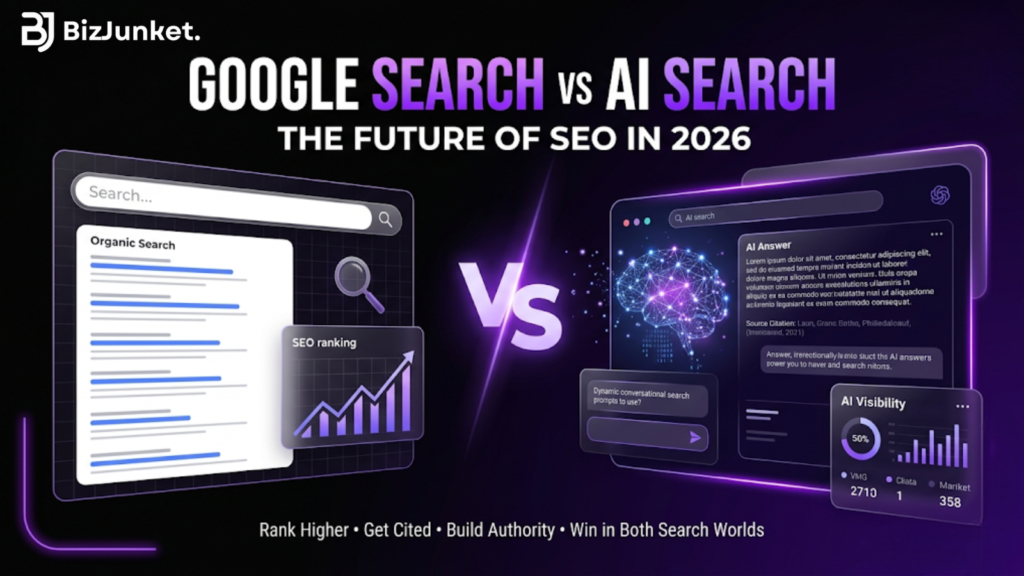
Table of Contents
Google Search vs AI Search: What’s Actually Different
| Traditional Google Search | AI Search (AI Overviews, ChatGPT, Perplexity, AI Mode) | |
|---|---|---|
| Output | Ranked list of links (10 blue links + SERP features) | A synthesized, conversational answer |
| Goal for marketers | Rank #1–3, earn the click | Get cited as a source inside the answer |
| Success metric | Rankings, CTR, organic sessions | Citation frequency, “share of model,” AI-referral traffic |
| User behavior | Scan, compare, click | Read the answer, sometimes click a source link |
| Content that wins | Comprehensive, keyword-optimized pages | Concise, well-structured, directly quotable answers |
Google hasn’t abandoned traditional search — AI Overviews now sit on top of the same organic results, pulling from the same index. But the presentation has changed fundamentally, and that changes user behavior, click patterns, and what “ranking” even means.
READ MORE How Backlinks Still Impact Google Rankings in 2026 (Complete SEO Guide)
What’s Happening to Organic Traffic
The data tells a nuanced story — not the “SEO is dead” panic headlines, but not business-as-usual either.
- Clicks on the top organic result are down. AI Overviews reduce clicks to the top-ranking page by roughly a third on average, as searchers get their answer without scrolling further.
- But total search volume is rising, and the absolute number of people clicking through to websites has stayed roughly flat — fewer clicks per search, but more searches overall.
- Impact varies heavily by industry. B2B and informational topics see AI Overviews on a large share of queries, while e-commerce and transactional searches are far less affected — Google still knows people need to click through to actually buy something.
- AI-referral traffic is exploding, even if it’s small in absolute terms. Visitors arriving from AI tools like ChatGPT tend to browse more pages and bounce less than traffic from traditional search, suggesting higher intent even at a fraction of Google’s scale.
- Google is still the dominant gateway. Google still fields tens of billions of searches a day compared to tens of millions on tools like ChatGPT — a gap of several hundred to one. AI search is important, but it isn’t a replacement for Google yet.
The takeaway: traffic isn’t disappearing, it’s redistributing — toward brands with strong topical authority and away from pages that only ever tried to rank for one narrow keyword.
Keyword Strategy for the AI Search Era
Keywords aren’t dead, but how you use them has to change.
1. Move from keyword-matching to topic clusters
Google Search vs AI search alike now reward pages that demonstrate depth across an entire subject, not just a page targeting one exact-match phrase. Build content around topic clusters — a strong pillar page supported by related subtopics — so both Google’s ranking algorithm and an AI model’s retrieval step see you as an authority.
2. Target question-based and conversational keywords
AI search tools respond to natural language questions (“what’s the best CRM for a 10-person sales team?”) rather than fragment queries (“best CRM small business”). Research the actual questions your audience asks — via People Also Ask, Reddit threads, and customer support tickets — and answer them directly and early in your content.
3. Don’t abandon high-intent, transactional keywords
E-commerce and bottom-of-funnel searches are the least likely to trigger an AI-generated answer, because the searcher needs to click through to actually complete an action. Traditional keyword optimization, product-focused landing pages, and strong on-page SEO fundamentals still convert real traffic here.
4. Track a new kind of keyword performance
Alongside rankings and search volume, start monitoring:
- Citation frequency — how often your content is referenced inside AI Overviews or chatbot answers for your target queries
- Share of model — how often you appear relative to competitors across AI platforms for the same query set
- AI-referral sessions — traffic arriving specifically from ChatGPT, Perplexity, Copilot, and similar tools (visible in most analytics platforms as a distinct referral source now)
SEO Strategies to Win in Both Google Search and AI Search
1. Structure content for extractability. Use clear headers, short direct-answer paragraphs near the top of a section, bullet points, and tables (like the one above). AI systems pull sentences and structured chunks out of context — content that’s easy to lift cleanly is content that gets cited.
2. Build topical authority, not just individual pages. Publish comprehensive, interlinked content around your core subject areas instead of scattered one-off posts. Both Google’s ranking systems and AI retrieval favor sites that clearly “own” a topic.
3. Strengthen E-E-A-T signals. Experience, Expertise, Authoritativeness, and Trustworthiness matter more than ever, since AI models weigh source credibility heavily when deciding what to cite. Author bios, original data, case studies, and cited sources all help.
4. Keep using structured data. Schema markup isn’t strictly required for AI features, but it still supports rich results in traditional search and helps machines parse your content accurately — there’s no good reason to skip it.
5. Build brand signals beyond your own website. Mentions, reviews, and citations of your brand across other reputable sites (forums, press, review platforms, social) feed both Google’s algorithm and the training/retrieval layers behind AI search tools. Being talked about elsewhere is becoming as important as what’s on your own domain.
6. Don’t create thin content just to cover every keyword variation. Google has explicitly warned that mass-producing near-duplicate pages to chase every possible AI query variation counts as scaled content abuse — it can get you penalized, not rewarded. Depth and usefulness beat volume.
7. Monitor performance in both worlds. Use Google Search Console’s Generative AI performance report alongside traditional rank tracking, and add AI-visibility tracking tools to see where you’re being cited across ChatGPT, Perplexity, and other AI search engines.
Conclusion
The debate over Google Search vs AI Search isn’t really about picking a winner — it’s about recognizing that “search” itself now has two front doors, Google search vs AI search and both lead back to the same core SEO fundamentals: authoritative content, clear structure, real expertise, and a strong brand presence beyond your own website. Google Search still commands the overwhelming majority of global queries, so ranking well there remains non-negotiable. But AI Overviews, ChatGPT, Perplexity, and Copilot are steadily training users to expect direct answers, and getting cited inside those answers is quickly becoming its own competitive battleground.
The businesses that will own the future of SEO are the ones that stop treating this as an either/or decision. Build topic clusters instead of isolated keyword pages. Write for humans skimming a results page and for AI models extracting a quotable answer. Track citation frequency and AI-referral traffic alongside rankings and clicks. Do that consistently, and you’re not just adapting to where search is headed — you’re positioning your brand to be the answer, wherever people go looking for it.